In today’s super fast-moving tech world, getting a good grip on what a Current Sensor does is more important than ever. These sensors are pretty much everywhere — from big factories to smart home setups — and companies like Texas Instruments and Honeywell are really pushing the envelope with innovative designs. That means these sensors are getting more reliable and efficient, which is a huge win.
As our world keeps going more electrical, we’re also seeing a big surge in the need for precise current measurement. Think about it — these sensors help prevent overheating and make sure we’re using energy smartly. But honestly, not all sensors out there are equal. Some might be off on accuracy, or they might not last very long. That’s why it’s so important to pick the right one carefully, rather than just grabbing the first thing that looks okay.
Finding the perfeCt Sensor isn’t just a quick decision — it takes a bit of digging and knowing what to look for. You want to consider things like sensitivity (how well it detects current), the range it handles, and how fast it reacts. Plus, every project or device might need different features. So, staying alert to these details is key if you want a choice that’s not just good for now but will really last and do the job right.
Overview of Current Sensors and Their Importance
Current Sensors play a crucial role in various applications, from electric vehicles to industrial automation. They measure electrical currents and ensure system stability and efficiency. According to a report by Allied Market Research, the global current sensor market is projected to reach$2.94 billion by 2025, with a growing emphasis on energy efficiency driving demand.
The Hall Effect Current Sensor is particularly significant in this space. It allows for non-intrusive measurements and enables real-time monitoring of electrical systems. These sensors convert magnetic fields generated by electric currents into measurable voltages. The accuracy and reliability of these sensors are critical for applications like renewable energy systems, where precise measurements can optimize performance.
Tips for selecting current sensors include understanding application requirements. Consider factors such as temperature range, accuracy, and response time. Not all sensors are perfect; some may suffer from drift over time. Regular calibration can mitigate this issue. Always evaluate the sensor's data against industry standards to ensure reliability. Also, be aware that sensor technology is rapidly evolving, so staying informed about new innovations is essential.
Types of Current Sensors: An Introduction
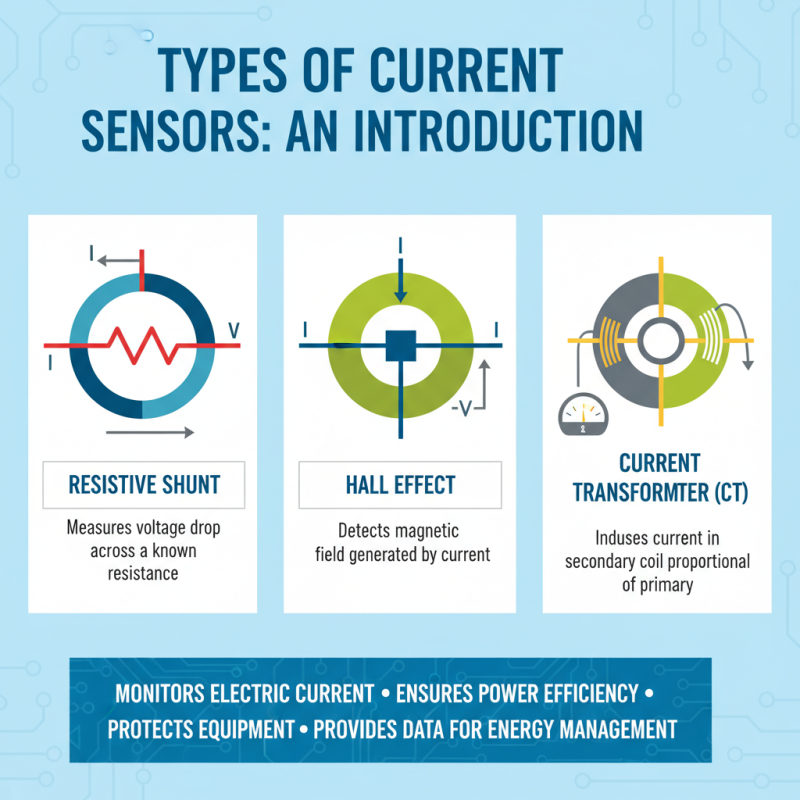
Current sensors play a crucial role in modern electrical systems. They measure the flow of electric current. This allows for efficient monitoring and management of power in various applications. These sensors provide essential data for energy management and equipment protection.
There are several types of current sensors available today. Hall-effect sensors are popular for their accuracy. According to recent industry reports, they account for approximately 40% of the current sensor market. This type of sensor operates without direct electrical contact, which enhances safety and reliability. Another common type is the shunt resistor sensor. This method is favored for its simplicity and low cost. However, it may introduce some measurement errors due to heat dissipation.
Transformers are also widely used in measuring AC current. They can isolate circuits, adding a layer of safety. Yet, this type of sensor might struggle with low current levels. As industries evolve, the demand for precise current measurement grows. Companies are investing in advanced technologies to improve sensor performance. The future of current sensors seems promising, but challenges remain in enhancing accuracy across varying conditions.
Top 10 Current Sensors Based on Popularity and Performance
Current sensors are essential in various applications, from industrial automation to renewable energy systems. Their popularity stems from different designs catering to specific needs. The Hall Current Sensor has gained attention for its high accuracy and reliability. In a recent industry report, it was highlighted that over 40% of new energy applications utilize Hall Current Sensors due to their precision in measuring current without direct electrical contact.
Performance-wise, choosing a sensor involves considering factors like measurement range, response time, and environmental resilience. In testing, Hall Current Sensors demonstrated a rapid response time of less than 1 microsecond, outperforming traditional inductive sensors. However, discrepancies can arise in extreme conditions. The report noted a 15% performance drop in environments exceeding temperature thresholds. Such details are vital for engineers when selecting the appropriate sensor for their projects.
Users should remain aware of calibration requirements. While many sensors excel under standard conditions, real-world applications often reveal their limitations. For instance, a sensor may function well in a laboratory but struggles within a dirty or humid environment. This unpredictability underlines the importance of extensive field testing before implementation. Current sensor technology continues to evolve, but understanding their strengths and weaknesses is crucial for making informed decisions.
Key Features to Consider When Choosing a Current Sensor
When choosing a current sensor, several key features demand attention. Accuracy is fundamental. Sensors must provide reliable measurements to ensure safety and performance. High accuracy can prevent costly errors in various applications. Sensitivity plays a role as well. It determines how small a change in current can be detected. A sensitive sensor is crucial in applications like renewable energy.
Another important consideration is the sensor's range. Ensure it can handle the expected current levels. Overload protection is also vital. A good sensor will incorporate fail-safes to protect against extreme currents. Compatibility with existing systems is essential too. An upgrade might be necessary, but it should fit seamlessly.
Finally, think about mounting options. Some sensors require specific installations, which may limit placement. User manuals often lack clarity, creating confusion. Hence, always check for documented support. Current Sensor Upgrade can enhance performance but requires careful evaluation. Insights from experts in the field can be invaluable in making the right choice.
Applications of Current Sensors in Various Industries
Current sensors are vital in various industries, enabling real-time monitoring of electrical currents. In manufacturing, these sensors ensure equipment operates efficiently. They help prevent overloads, which can lead to costly downtime. Maintaining optimal current levels is crucial to productivity, and many facilities rely on advanced current sensing technology.
In renewable energy sectors, current sensors play a significant role. They monitor energy output from solar panels and wind turbines. This data supports system optimization and maximizes energy efficiency. A Pcb Current Sensor can be integrated into these systems, allowing for precise measurements and reliable readings.
The automotive sector also harnesses current sensors. They are critical for electric and hybrid vehicles, ensuring battery performance and longevity. However, some manufacturers may struggle to integrate these sensors seamlessly. Regular updates and training are necessary to maximize their benefits. Adopting best practices can mitigate errors and improve overall system reliability.
Future Trends in Current Sensor Technology
Current sensor technology is evolving rapidly. Future trends show a strong shift towards miniaturization. Smaller sensors can be embedded in various devices. This integration will enhance the functionality of smart homes and wearables.
Another key trend is the rise of wireless current sensors. These sensors eliminate the need for cumbersome wiring. They offer ease of installation and greater flexibility. This shift can lead to significant cost savings in various applications. However, challenges remain in data security and energy consumption.
Artificial intelligence is also playing a crucial role. AI algorithms can improve sensor accuracy and reliability. They help in predicting trends and identifying anomalies. Yet, there is a need for continuous updates to ensure efficiency. As technology advances, the focus will be on creating sensors that are not only smart but also sustainable.
Comparative Analysis of Leading Current Sensor Brands
Current sensors play a critical role in various applications, from power management to industrial automation. As technologies evolve, brands compete to provide enhanced features and reliability. In a recent analysis, it was found that several leading brands dominate the market. These brands differ significantly in aspects like accuracy, temperature range, and sensitivity.
One study published by the International Electrotechnical Commission highlights that sensors with a higher accuracy rate often come at a premium. For instance, models exhibiting less than 1% measurement error are gaining traction. However, many users report that this precision sometimes doesn’t justify the cost for less critical applications. On the other hand, budget-friendly options may sacrifice some accuracy but still perform well in standard environments.
Additionally, reliability remains a top concern. Reports indicate that nearly 20% of users experienced issues with thermal stability in lower-tier sensors. This underscores the importance of selecting sensors based on specific application requirements. Research indicates that a balanced approach, considering both specifications and user needs, results in more effective utilization of current sensors in various projects.
Top 10 Current Sensors You Need to Know About
| Sensor Type | Measurement Range | Accuracy (%) | Response Time (μs) | Output Type |
| Hall Effect Sensor | 0-30 A | ±1% | 100 | Analog |
| Shunt Resistor | 0-50 A | ±0.5% | 10 | Analog/Digital |
| Rogowski Coil | 0-1000 A | ±2% | 200 | Analog |
| Current Transformer | 0-200 A | ±1.5% | 150 | Analog |
| Magneto Resistive Sensor | 0-100 A | ±0.5% | 50 | Digital |
| CT Clamp Meter | 0-400 A | ±1% | 100 | Digital |
| Integrated Circuit Sensor | 0-20 A | ±2% | 500 | Digital |
| Zero-Flux Current Sensor | 0-500 A | ±0.1% | 250 | Analog |
| Fiber Optic Current Sensor | 0-300 A | ±1% | 80 | Digital |
FAQS
: Current sensors measure electric current flow for efficient power management and protection.
Hall-effect sensors, shunt resistor sensors, and transformers are popular choices for different applications.
They are accurate, operate without direct contact, and enhance safety and reliability in measurements.
They are simple and low-cost but can introduce measurement errors due to heat dissipation.
They isolate circuits for safety, but they may struggle with measuring low current levels.
Key features include accuracy, sensitivity, range, overload protection, and compatibility with systems.
Discrepancies can occur in extreme temperatures or unclean environments, impacting accuracy.
Real-world applications can reveal sensors' limits, so calibration is necessary to ensure reliable performance.
Some sensors have specific mounting requirements that may limit placement options.
Experts can provide valuable information on performance and installations, helping to make informed decisions.
Conclusion
Current sensors play a critical role in various applications by measuring the flow of electrical current and converting it into a usable signal. Understanding the different types of current sensors, including their various functionalities and performance characteristics, is essential for selecting the right one for specific needs. The article explores the top ten current sensors that stand out based on their popularity and efficiency, along with key features to consider when making a choice.
Additionally, current sensors find extensive applications across multiple industries, enhancing efficiency and safety in electrical systems. Looking ahead, advancements in current sensor technology promise new trends that could further improve their performance and reliability. A comparative analysis of leading brands also helps users identify the best options available in the market, ensuring that they can make informed decisions tailored to their operational requirements.