





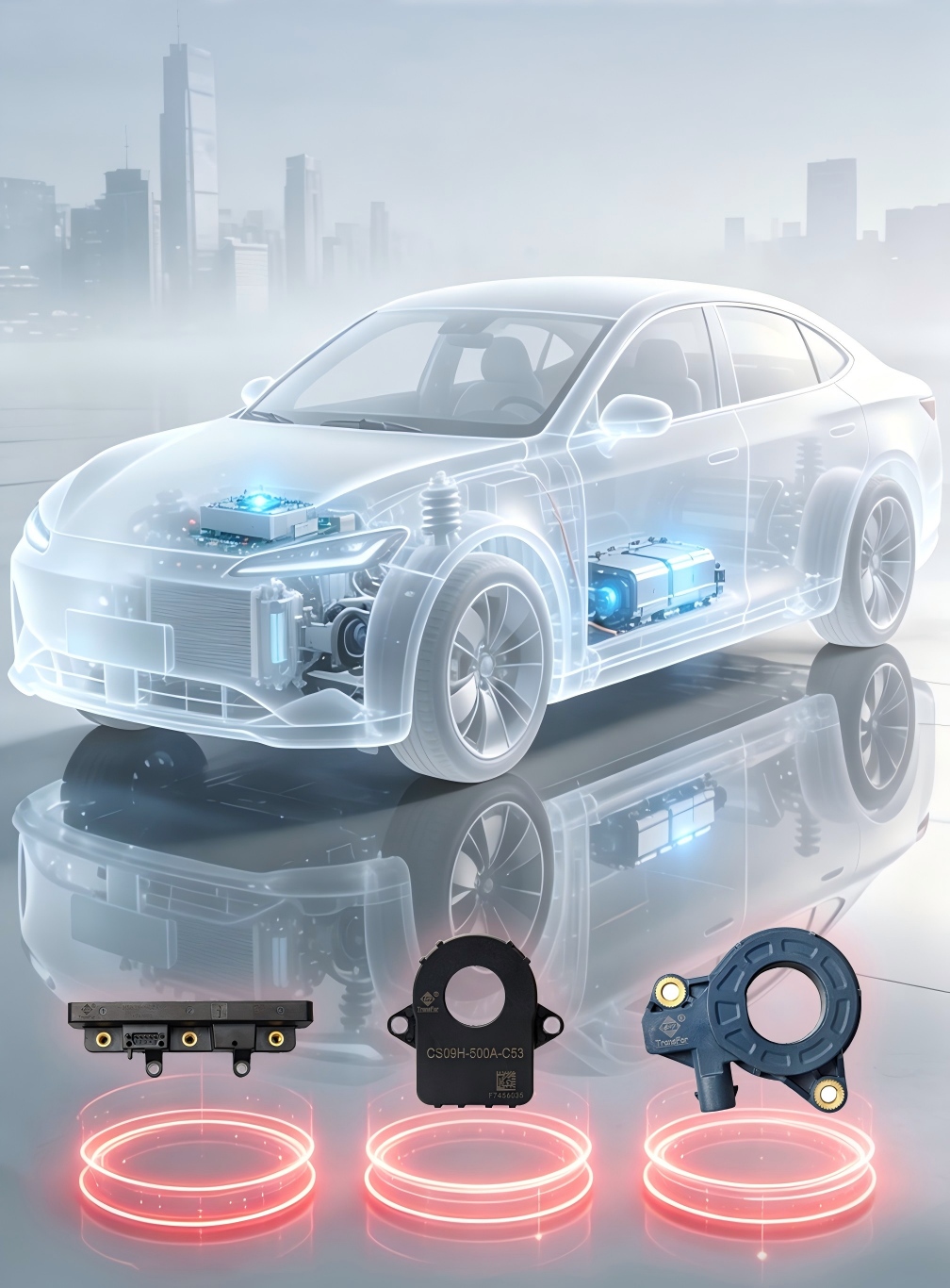


Seven Sources of Sensor Circuit Noise
There are seven main types of sensor circuit noise:
1. Low frequency noise
Low-frequency noise is mainly caused by the discontinuity of internal conductive particles. Especially for carbon film resistors, there are many tiny particles inside the carbonaceous material, and the particles are discontinuous. When the current flows through, the conductivity of the resistor will change, causing the current to change, resulting in a flash arc similar to poor contact. In addition, transistors may also produce similar burst noise and flicker noise. The generation mechanism is similar to the discontinuity of particles in the resistor, and is also related to the doping level of the transistor.
2. Shot noise generated by semiconductor devices
Since the change in the voltage of the barrier region at both ends of the semiconductor PN junction causes the amount of charge accumulated in this region to change, the capacitance effect appears. When the external forward voltage increases, the electrons in the N region and the holes in the P region move toward the depletion region, which is equivalent to charging the capacitor. When the forward voltage decreases, it drives electrons and holes away from the depletion region, which is equivalent to capacitive discharge. When a reverse voltage is applied, the depletion region changes in the opposite direction. When current flows through the barrier region, this change causes small fluctuations in the current flowing through the barrier region, thereby generating current noise. The amount of noise it generates is proportional to temperature and frequency bandwidth △f.
3. High frequency thermal noise
High-frequency thermal noise is caused by the irregular movement of electrons inside conductors. The higher the temperature, the more intense the electron movement. The irregular movement of electrons inside a conductor will form many tiny current fluctuations inside it. Because it is a disordered movement, its average total current is zero. However, when it is connected to an amplifier circuit as a component (or as part of a circuit), the current inside it will be amplified and become a noise source, especially the high-frequency thermal noise of circuits working in the high-frequency band.
Usually within the power frequency, the thermal noise of the circuit is proportional to the pass frequency band. The wider the pass frequency band, the greater the impact of the circuit thermal noise. Taking a 1kΩ resistor as an example, if the passband of the circuit is 1MHz, the effective value of the open circuit voltage noise appearing across the resistor is 4μV (assuming the temperature is room temperature T=290K). It seems that the electromotive force of the noise is not large, but if it is connected to an amplifier circuit with a gain of 106 times, the output noise can reach 4V, which will cause great interference to the circuit.
4. Interference from electromagnetic components on the circuit board
There are electromagnetic components such as relays and coils on many circuit boards. When current passes through, the inductance of the coils and the distributed capacitance of the housing radiate energy to the surroundings, and the energy will cause interference to the surrounding circuits. Components such as relays work repeatedly, and when the power is turned on and off, they will generate instantaneous reverse high voltage, forming an instantaneous surge current. This instantaneous high voltage will have a great impact on the circuit, thus seriously interfering with the normal operation of the circuit.
5. Transistor noise
The noise of transistors mainly includes thermal noise, shot noise, and flicker noise.
Thermal noise is generated due to the irregular thermal movement of carriers through the body resistance of the three zones within the BJT and the corresponding lead resistance. Among them, the noise generated by rbb is the main one.
What is usually called the current in a BJT is just an average value. In fact, the number of carriers injected into the base region through the emitter junction is different at each instant, so the emitter current or collector current fluctuates irregularly, which produces shot noise.
The noise caused by poor cleaning of the transistor surface due to semiconductor materials and manufacturing process levels is called flicker noise. It is related to the recombination of minority carriers on the semiconductor surface, manifested as the fluctuation of the emitter current, and its current noise spectral density is approximately inversely proportional to frequency, also known as 1/f noise. It mainly plays a major role in the low frequency (below kHz) range.
6. Resistor noise
The interference of the resistor comes from the inductance and capacitance effects in the resistor and the thermal noise of the resistor itself. For example, a solid resistor with resistance R can be equivalent to a series and parallel connection of resistor R, parasitic capacitance C, and parasitic inductance L. The parasitic capacitance is 0.1~0.5pF, and the parasitic inductance is 5~8nH. At frequencies higher than 1MHz, these parasitic inductances and capacitances cannot be ignored.
Resistors all generate thermal noise. When a resistor with a resistance of R (or the body resistance of a BJT or the channel resistance of a FET) is not connected to the circuit, the thermal noise voltage generated in the frequency band B is: k is Boltzmann's constant; T is the temperature (unit: K). The thermal noise voltage itself is a non-periodic changing time function, and its frequency range is very wide. Therefore, wide-band amplifier circuits are more affected by noise than narrow-band amplifiers.
Resistors produce contact noise, and the contact noise voltage formula is: I is the mean square value of the current flowing through the resistor; f is the frequency; k is a constant related to the geometric shape of the material. Because Vc plays an important role in the low frequency band, it is the main noise source of low frequency sensors.
7. Noise from integrated circuits
There are generally two types of noise interference from integrated circuits: one is radiation type and the other is conduction type. These noise spikes will have a greater impact on other electronic equipment connected to the same AC power grid. The noise spectrum extends beyond 100MHz. In the laboratory, you can use a high-frequency oscilloscope (above 100MHz) to observe the waveform between the Power Supply and the ground pin of an integrated circuit on the general microcontroller system board, and you will see noise spikes - the peak value can reach hundreds of millivolts or even volts.